
Water reed, or Norfolk reed as it is often known, is used in great quantity across England and mostly imported from Europe. It is long, tough and durable and, with no great wheat tradition in Cumbria, it will be the best choice of thatching material for timbered roofs with no thatch undercoat..
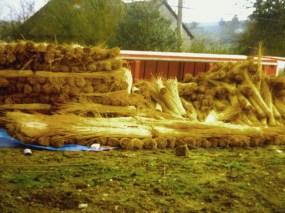
It is a natural and sustainable resource, growing annually on natural and carefully managed reed beds. Harvesting is done in winter and starts after the leaves have fallen away continuing until the spring growth begins. Water reed is the commonest form of thatch in Europe being used from in the Baltic countries and throughout northern Europe. Here is a link to a very interesting overview of water reed’s versatility. www.youtube.com/watch?v=W870tsu_L0Y
Here in England water reed is usually fixed to the roof timbers with steel bar and hooked nails (as shown here) or screw fixings.
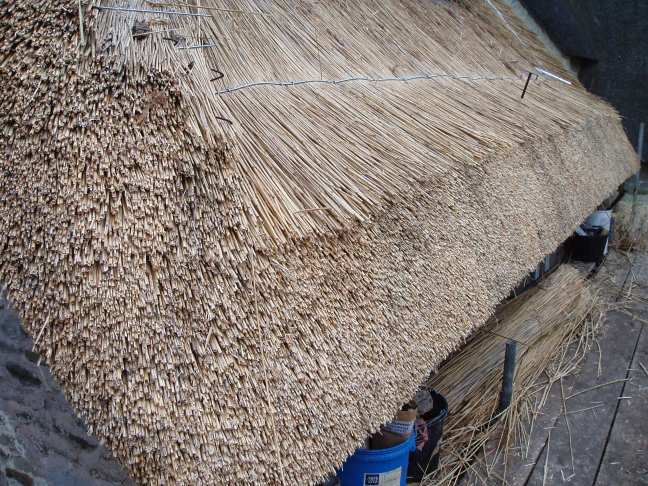
It can also be spar-fixed to an existing thatch background although this is not always recommended. (For a detailed explanation of my reasons for asserting this, see my ‘wheat over water’ article in Dorset Life.) (link )
Below is a picture of work where the reed is being fixed down using both forms of fixing. On the right a new course is temporarily fixed. In the middle, where two bundles are resting, steel can be seen where the reed is being fixed directly to the roof frame of the extension. Beyond this area, over the forming eyebrow and hip, the reed is being spar-bonded to an undercoat on the original building. (Note the double fixing required for this technique.)
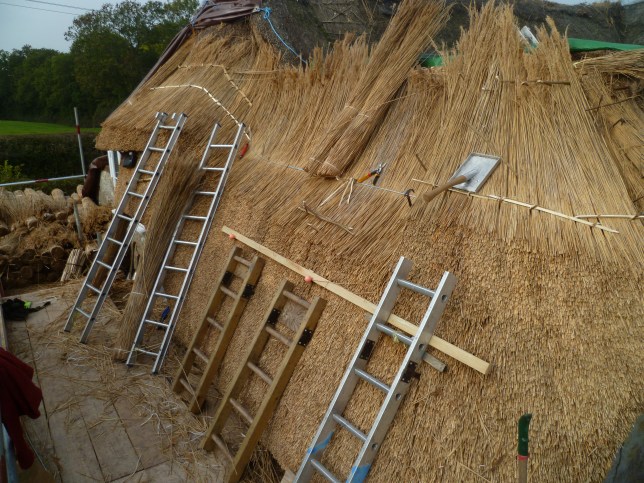
The finished eyebrow/hip with new extension to the lower right of the picture…
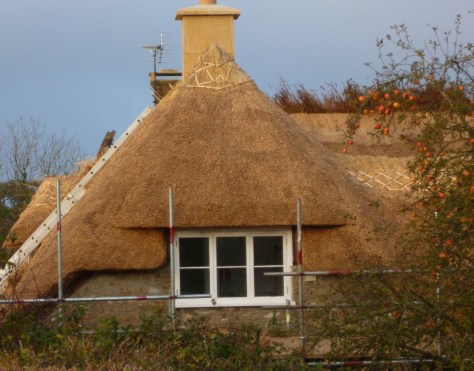
Below is a water reed roof is being held on to the timbers with screw ties. (The roof structure is mostly obscured by the addition of some back-fill to keep the new thatch running smoothly over the battens.)
![IMG_20160430_141716[1]](https://kendalthatcher.net/wp-content/uploads/2015/11/img_20160430_1417161.jpg?w=636&h=477)


 kendalthatcher.net